Finding The Words
Warning - This essay discusses sexual trauma.
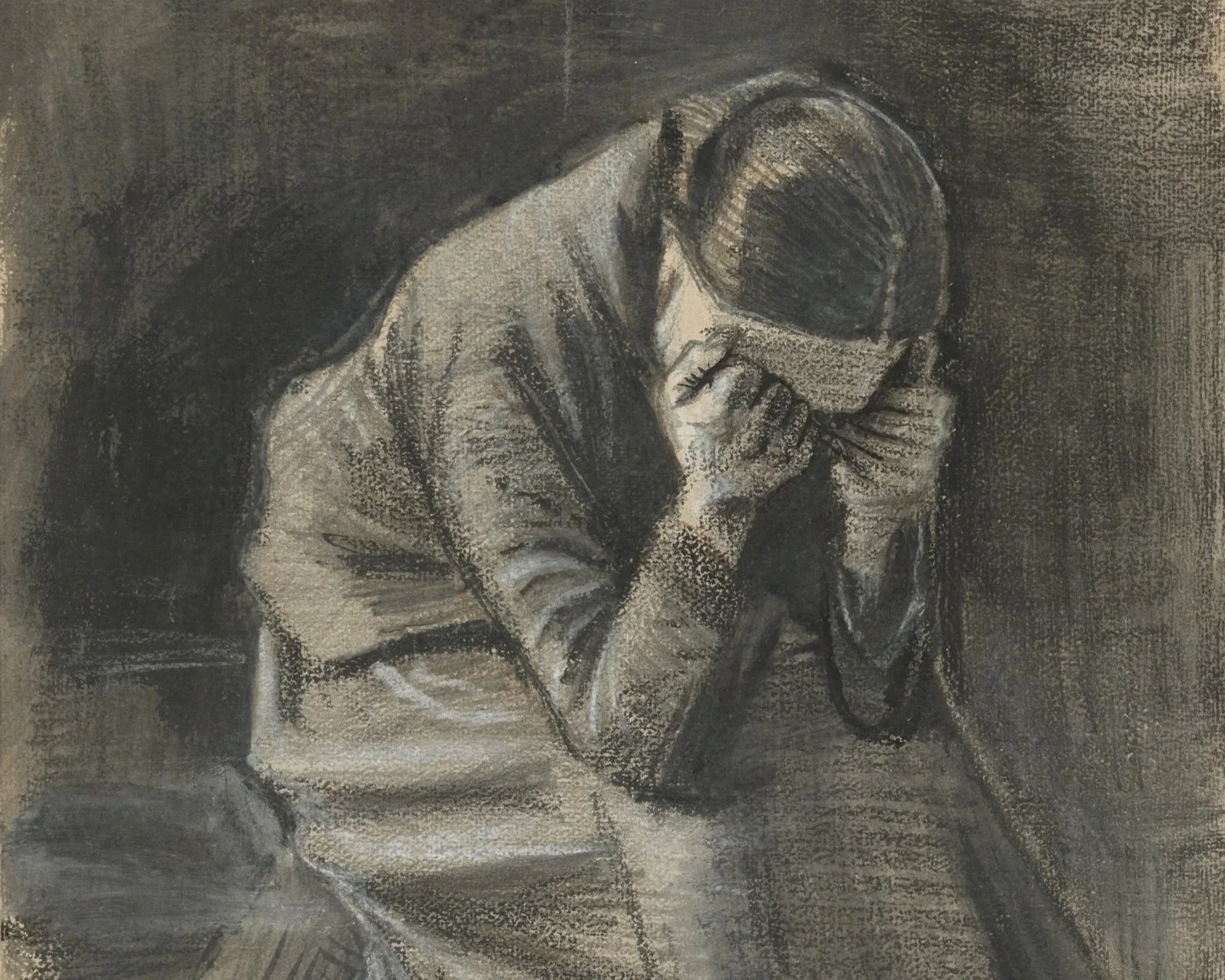
Vincent van Gogh, Weeping Woman, 1883
When I was a sophomore in college, I took one of my favorite courses. It was a Sociology class called Self & Society and it focused on the cultural influences that foster or hinder the process of identity formation. In this class, and every class, I was an active participant. I loved being a student. I enjoyed both asking questions and sharing my opinions. I highlighted sections of the reading I wanted to reference in discussion. I would offer a counter to an idea I did not agree with. And yes, I was the student who raised my hand to say just one more thing as the professor was wrapping up class. The classroom was always a place where my voice came through clear, strong, and confident.
For our final assignment, I turned in an essay titled: A Struggle to Create Feminine Identity Within the Confines of Cultural Norms. Like every budding feminist, I wrote about the discrepancy between the societal ideal of femininity and the reality of women’s lives. I discussed the challenges inherent in establishing a sense of self in a culture that trains women to cater to the needs of others. And I highlighted the lack of recognition women face in a world set on labeling them as incompetent, submissive, and irrational. While I received an exemplary grade on my paper, my heart sank a little when I saw the comment on the bottom right corner of the page. The professor had written, “Surely you have never let cultural crap thwart you!” I know it was written as a word of encouragement. It was meant to signal that I did not seem to be confined by the societal standards I wrote about. It implied I was not the type of woman that would let patriarchal values define me.
When I read the comment, I felt unheard. The entire reason I wrote the essay was because I was struggling to navigate these very challenges. In fact, at nineteen, I was drowning under the pressures of “cultural crap.” This professor didn’t know that I had filled journals with worries about my body, my looks, my behavior — constantly wondering if I was enough. This professor didn’t know that I was shrinking myself for male attention. This professor didn’t realize that the classroom was the only area my voice came through so strong and clear. And neither of us knew that in just a few years time, I would lose my voice completely at a moment when it mattered the most.
The Words I Did Not Have
I met him at a bar on St. Patrick’s Day. We talked, we danced, we kissed, we exchanged numbers. Later, at the restaurant we went to for our first date, I learned he was ten years older than me, a lawyer. Unsurprisingly, given the age gap, we didn’t have much in common. We were at very different stages in our lives. The conversation was halting, but we both liked sports, so we let that carry us through the evening. If I were older, I would have known to trust my lack of enthusiasm, but I was only twenty-three and still eager to fill that void of enoughness with male attention.
I was surprised when he called a few days later to invite me to watch a basketball game at his place. I remember taking a cab to his apartment. As I sat in the backseat watching the buildings go by, it occurred to me that this was a part of Chicago I had never been to before. As soon as I entered, he offered me a beer and we sat on the couch as the game began. And then everything happened very fast.
Before I could even take a sip of my drink, he was kissing me. And then in a flash, my clothes were being peeled off my body. The next thing I knew, I was laying on the cold hardwood floor as his hands traveled all over me. I have no memory of the sound of the game. I don’t recall him saying anything. But my head pounded with the sounds of my internal dialogue. I remember a harsh voice telling me that if I didn't want this, I should not have agreed to come. If I told him to stop now, I would be a tease. If I said no, he might get angry. If I stopped now, would that hurt him? It was my fault for coming here. It’s too late to stop. And all of these excuses were being shouted over a guttural, internal wail. But to him, I said nothing.
The next thing I knew I was laying on the bed in his room on top of the covers, exposed and scared. That's when I felt the pain deep within my core. And then, suddenly, it felt like I traveled to another place. I was not in my body. I was floating above myself, disconnected from my own reality. Did he even see me go?
Finally it stopped. He kneeled over me and said the only words I remember him speaking that day, “Was it ok for you?” I remember giving the smallest of nods as a tear dripped down the side of my face. My voice and my sense of self - both absent.
I have no memory of what happened next. I do not remember how long I stayed or how I got home. I do not remember what I did that evening or if I spoke to anyone. But I do remember my internal voice returning to explain away what happened. The voice that reminded me it definitely wasn’t rape because I didn’t say no. The voice that told me I couldn’t blame him because I can’t expect someone to be a mind reader. The voice that decided that in his passion, he just couldn’t see me. The voice that wrote it off as just bad sex. The voice that decided I would not make a big deal out of this. The voice that reminded me incessantly, you didn’t say no. You didn’t say no. You didn’t say no.
The Wrong Words
I can see that what I struggled with in the aftermath of that day was a problem of assimilation. First, I did not know how to square my experience with what I knew assault to be. I’d been told to avoid strangers coming out of dark alleys, spiked drinks at frat parties, and walking home alone. No one warned me it could happen at noon on a Saturday, completely sober on a second date. Because my knowledge of assault was limited to violent attacks committed by strangers in the night, my brain did not know where to file this event, which I’m sure is how it ended up tagged as something in the grey area.
Second, I didn’t know how to incorporate my response in the moment to who I wanted to be. I still desperately wanted to be a strong, confident woman who spoke up for herself. A woman who would put up a fight. I was still clutching to the belief that I was the type of woman who didn’t put up with this crap. But my response put that all into question. I felt like I’d let my guard down and proven my incompetence by failing to keep myself safe. I kept thinking that if I’d only found the courage to say no, I could have prevented all the pain. But instead, my fear locked up my voice, and I simply submitted. Was I really all those words patriarchy had labeled me as?
I did not make deliberate decisions about how to proceed. There was no pros and cons list created to decide whether or not I should acknowledge this experience. Perhaps my inability to put words to this moment came from a place of shock or shame. But I think it’s more accurate to say my actions after this event arose from a place of self-preservation. At twenty-three, my identity was just emerging. I was still trying to figure out who I was, what I wanted to do with my life, what I valued. If I let this moment define me, I felt it would swallow me whole. If I identified with the version of myself who existed on that day, there would be nothing there. On the one hand, downplaying this experience would mean gaslighting the girl who lived through it, but on the other, suppressing it was a defiant refusal to be erased by it. I dug my claws into the version of myself I’d been trying to create before it happened and then I never let go. I told myself I’d made a mistake, I called it a bad experience, and then, like suffocating a fire, I buried it out of sight.
The Words That Silenced
Looking back at the essay I wrote sophomore year, I am struck by all the words I had to describe the systems that shape women’s lives. I could so clearly outline the distorted cultural beliefs that I was struggling against. And yet, somehow, this knowledge did nothing to protect me. As I review all the internal messaging that ran through my head on that day, it is obvious that all those words forced their way inside of me long before he did.
Woman as tease, woman as incompetent, woman at fault for the violence committed against her. Society told me it was my job to avoid danger and prevent harm and I had failed. I can see now that my heart sank when I read the comment on my college paper because it upheld the false belief that there is a type of woman I could have been to stay safe. The pressure of that landed heavy on my shoulders. After that day, the pressure melted into shame, and the shame melted into silence.
Even now as I write this, I can still hear a faint internal voice trying to prevent me from sharing this story. It tells me that this is not worth sharing if I’m not adding anything new to the discussion of sexual assault. It tells me that I need to wait until I have all the perfect words. It tells me it is not worth sharing until I can communicate all the lessons. It tells me that I will not be believed.
The Words For Context
Slowly, throughout the past seventeen years, I began to uncover the words I needed to make sense of what happened to me. I had read about fight or flight many times and questioned why my body had not responded in this way. Why didn’t I scream no? Why didn’t I push him away? Where was my fight? And then one day, I saw a third option listed: fight, flight, or freeze. Each of these is an involuntary response to a threat. The freeze response is not chosen by your rational mind. It is the response selected automatically when a threat is determined to be physically stronger and faster. It is the most common response for women who experience assault.
I also learned about dissociation and suddenly I had a word for where I’d drifted off to in that moment. Another survival tactic. A way to separate myself from the pain. Within these words I began to find a little space - a small easing of the clamp I’d placed on my fragmented memories. Room enough to take a little breath and allow for the first small shift in perspective.
And then one day I read them - all their stories. The #MeToo movement brought a flood of words from women that were both harrowing and illuminating. Their words began to expand my understanding of what assault looked like and who committed these acts. I came across stories that mirrored my experience. For the first time, I allowed myself to acknowledge that what happened to me was more than just bad sex. These stories broke my heart, but they also made me feel less alone. Sadly, their words also taught me that saying no was not a guarantee of safety. While it is often the only weapon women are instructed to use to ward off unwanted behavior, it can just as easily have the opposite effect. I will never know how speaking up would have shifted my experience, but these stories allowed me to view my silence in a new light. In recognizing my silence as an attempt to reduce harm, a little more space began to open up. Enough to finally plant the seeds of forgiveness I would need to heal.
The Words That Expand
A sense of self is just a story, a collection of words we hold dear. It is the story we tell ourselves and the story we want others to believe in order to feel seen. I keep revisiting this event in my mind because I want to believe there is something I could have done to make him see me. I want to believe I can build a self so undeniable that it could never happen again. Ever since that moment, I have been scrambling around seeking validation that I am here, that I am strong, that I am competent, that I exist on my own terms. I have been hustling to ensure that others perceive me the way I want them to. And yet I often refuse to recognize myself. I refuse to accept my own story, my own version of how I feel and why.
When I finally found the courage to share this with my family and a few close friends, I began to compile all the information about what happened, why I responded the way I did, and why I’d kept it to myself for so long. Within this process, I realized what I had been doing all these years was building my defense. Society had taught me that I would not be believed. For seventeen years I’d been trying to prove my version of what happened. But I am one of the lucky ones. It turns out they didn’t need my defense. They simply met my story with love, understanding, and care. I know that once I’m able to do that for myself, a great ache will be released.
For so long, I’ve defined strength as endurance. My version of strength involved a stiff upper lip. But there is also strength in honesty. There is strength in acceptance. The word rape still fits onto my identity like an itchy, ill fitting sweater. But maybe in expanding enough to acknowledge that this, too, is a part of my story, I can move from anxiously protecting my identity back towards eagerly and imaginatively creating it.
